“Just the tool I need.”
I had a bad experience with a solar lease. But I'm considering trying again and so happy I found ASSET. It gave me an independent, clear breakdown of my solar and storage potential.
Free · No-Obligation Energy AnalysisASSET V2.0
Take control of your home energy.Independent solar design + battery sizing.
Instant energy intelligence and utility savings projections, at your own pace.
ASSET: The Advanced Solar & Storage Evaluation Tool
Turn your energy into an ASSET.

Independent | Accurate | Easy to use
Your solar + battery plan in 4 steps
Step 1 · Locate
Enter your address.
We instantly analyze your roof geometry, shading, and local utility rates using professional-grade modelling.
Step 2 · Estimate
View instant snapshot.
Get an immediate, objective look at your home's baseline solar potential and battery options, costs, savings, and payback period.
Step 3 · Design
Build your system.
Drag and drop panels onto a real image of your roof and size a battery system to maximize savings.
Step 4 · Connect
Match with local installers.
Share your blueprint with vetted companies in your state. Select from our recommended matches or choose your own from our full directory, free.
Factor C Energy doesn't sell or install solar panels or batteries.We developed ASSET to give homeowners the independent data they need to make informed decisions.
What Homeowners Are Saying About ASSET
“Surprisingly easy to use.”
It's simple, really. I just want intel on what solar can produce and what a battery can back up. I used ASSET and easily got the data I needed in minutes.
“The perfect starting point for solar research.”
ASSET made my initial planning phase effortless. When we sit down with solar companies, having our independent report ready means we can get straight to building the right system.
Built for homeowners
The First Solar & Battery Calculator Built for Homeowners.
Now everyone can access professional-grade planning tools. ASSET gives you clear solar and battery insights, made simple for an effortless experience.
LiDAR-Backed Solar Modeling
Access high-resolution aerial data and solar models. ASSET analyzes roof geometry, tilt, azimuth, shading loss, and solar intensity. You get precise and accurate energy data before you ever place a panel.
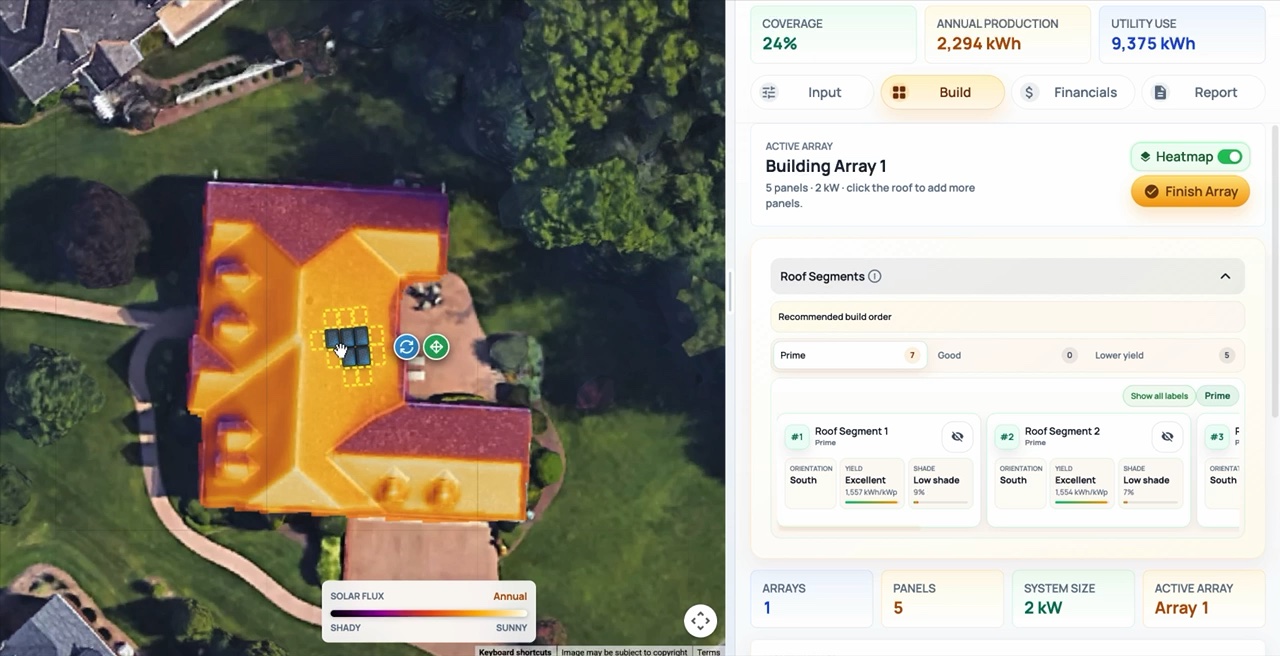
Actual ASSET analysisSolar flux
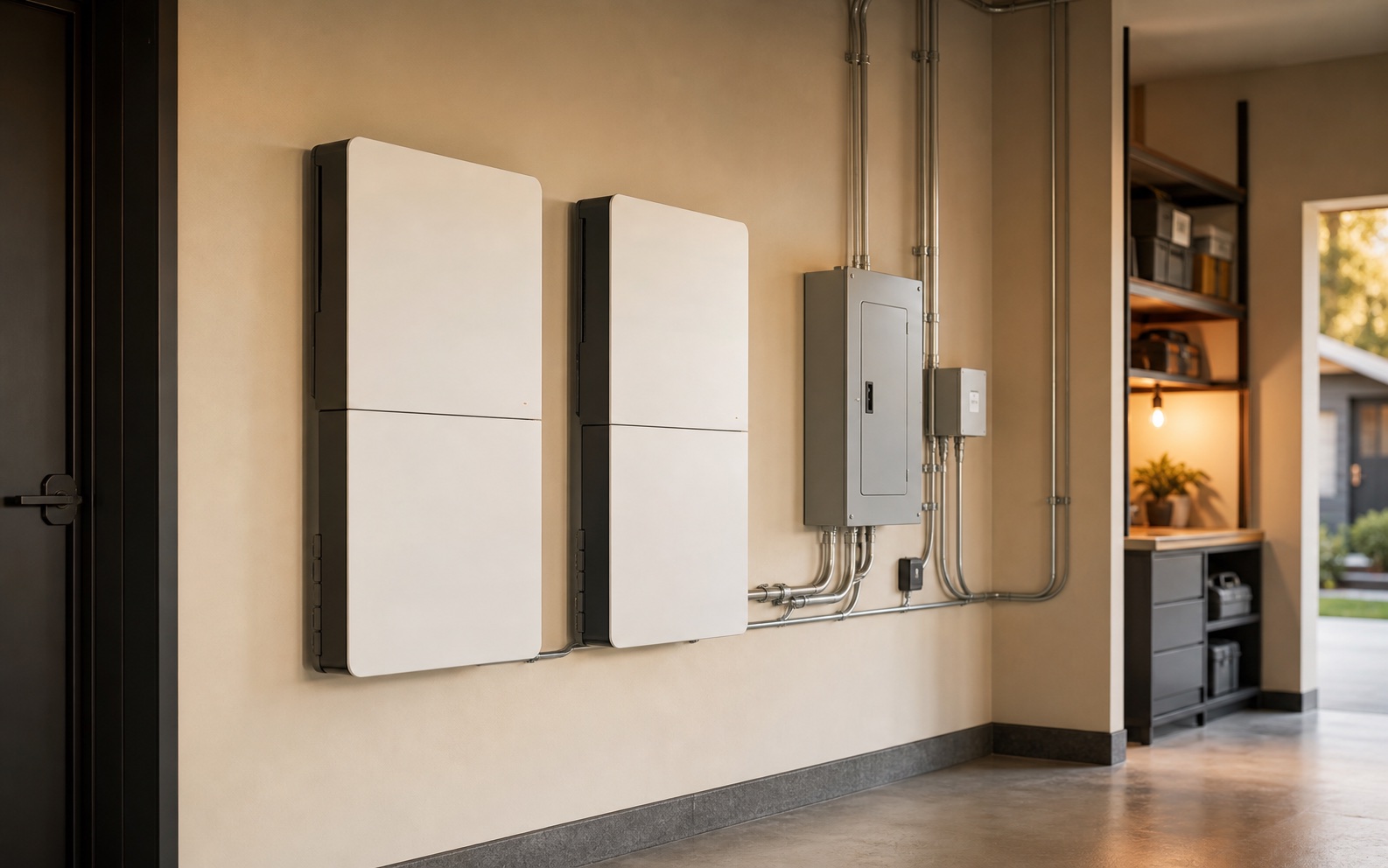
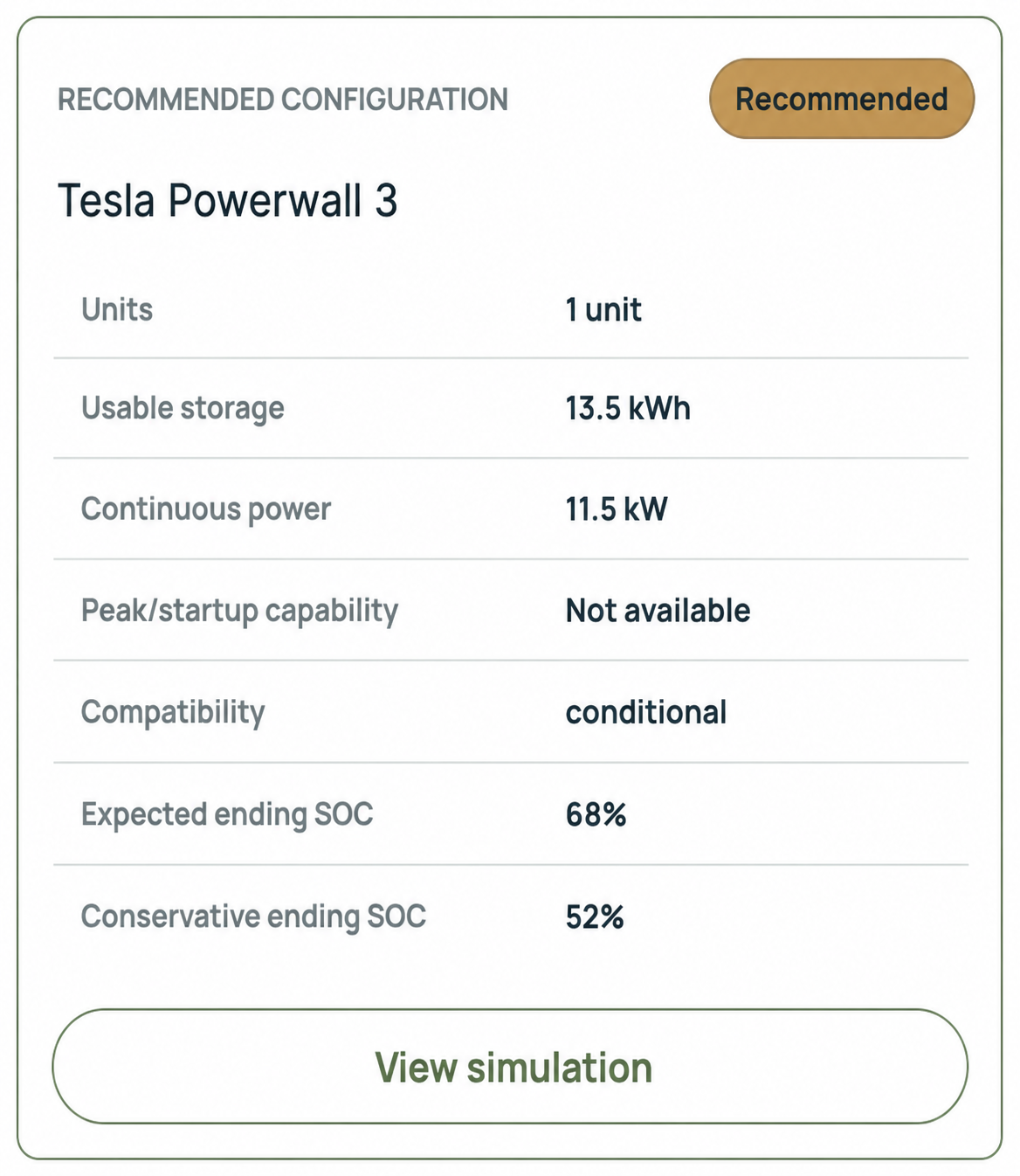
Know your storage potential.
What do the numbers say? Get insights grounded in real electrical engineering constraints. Size storage by calculating total energy needs, continuous output limits, and motor-start inrush surge, ensuring your battery plan delivers blackout protection.
Intuitive Controls
Easily unlock solar physics and balance-of-system calculations in under two minutes. Design custom panel layouts directly on high-resolution roof imagery with real-time feedback on system production.
Your Custom ASSET Report
Does investing in a solar and battery system make sense? ASSET gives you 100% independent analysis. Evaluate payback year, Levelized Cost of Energy (LCOE), Return on Investment (ROI), Internal Rate of Return (IRR), and 20-year cash flow projections. Download your contractor-ready PDF baseline and decide on your own terms.
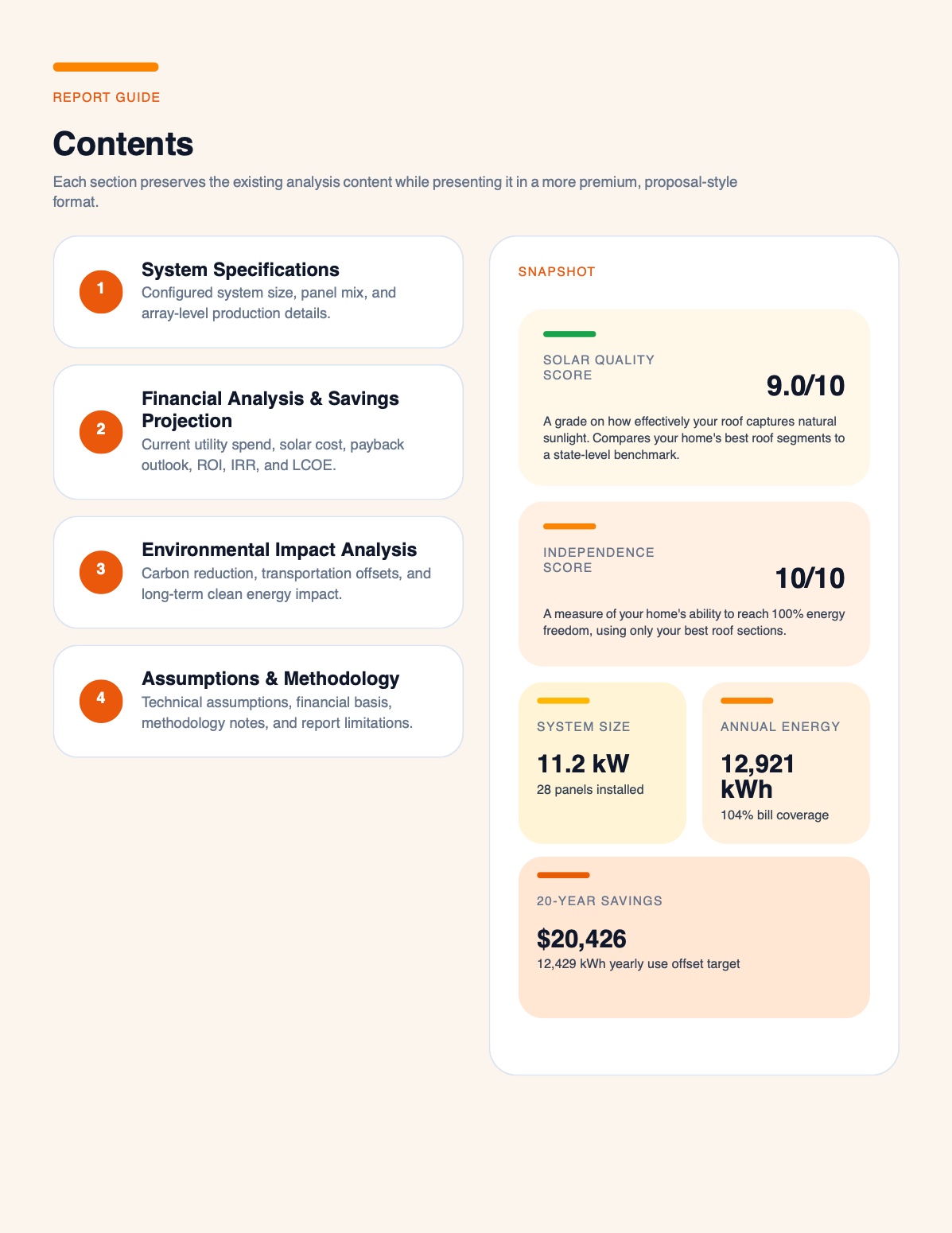
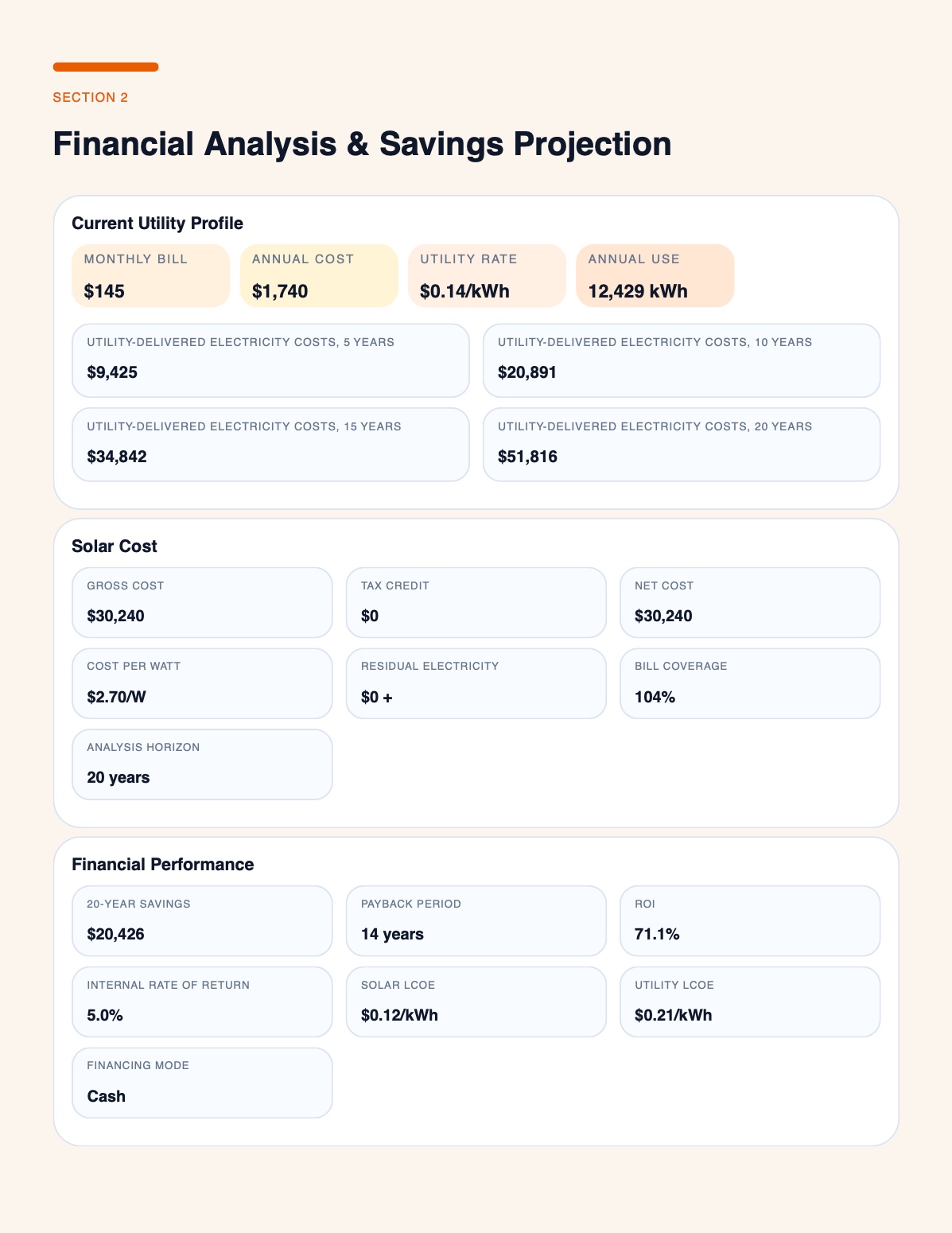
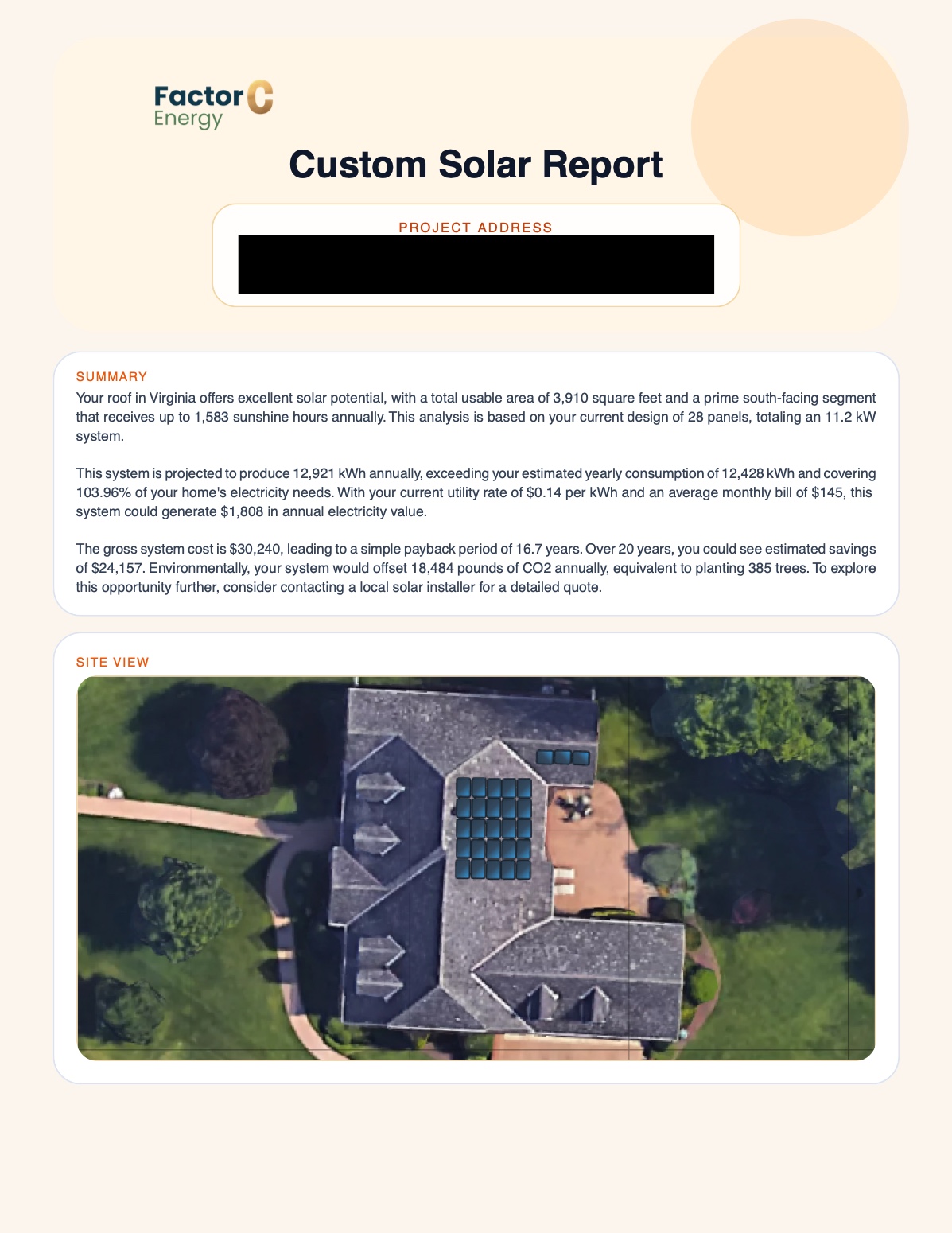
Real downloadable reportPDF
Frequently Asked Questions
What is ASSET?
ASSET (Advanced Solar & Storage Evaluation Tool) is an independent energy analysis platform developed by Factor C Energy. It provides homeowners with professional-grade modeling tools to evaluate their solar and battery potential and understand financial costs and benefits.
ASSET eliminates guesswork by creating a custom, clean-energy blueprint for your home. By delivering transparent performance and financial data, it empowers you to make informed decisions and turn your home's energy into a lasting financial ASSET.
What solar design and battery sizing tools does ASSET provide?
ASSET provides three integrated evaluation tools: a Solar & Battery Snapshot for instant energy & savings estimates, a georeferenced Solar Design Tool for drag-and-drop panel layouts, and a Battery Sizing Module for targeted backup modeling.
- Solar & Battery Snapshot: Delivers instant baseline estimates for solar production, battery storage requirements, and key financial metrics like bill savings, payback timelines, and ROI, among others.
- Solar Design Tool: Enables you to design a custom solar panel layout by building arrays directly onto a high-resolution, georeferenced satellite picture of your roof.
- Battery Sizing Module: Models your emergency backup needs using either a targeted critical-appliance selection or a whole-home coverage strategy.
How does Factor C Energy protect my personal data?
Factor C Energy operates under a strict privacy-first policy. Your personal information and energy usage details are used strictly for building your custom solar design and utility rate modeling. We do not sell your personal contact info or design data to third-party lead generators.
Unlike traditional solar calculators that auction your personal details to aggressive sales teams, ASSET is a 100% independent modeling engine. You maintain complete ownership of your data, and we will only connect you with vetted local installers if you explicitly grant permission during Step 4 (Connect).
What data sources and engineering methods power ASSET's solar calculations?
ASSET integrates data from leading geospatial services and national labs—including Google Solar API, EIA, and NREL datasets. The modeling system synthesizes four technical layers: 3D spatial roof geometry, 8,760-hour annual site shading simulations, utility-rate and household-energy datasets, and realistic system-loss derate factors like inverter conversion and thermal degradation.
- 3D Roof Geometry & Aerial Imagery: Georeferenced spatial data captures exact roof pitch, surface area, and orientations (azimuth).
- Hourly Site Shading: Annual sun trajectories evaluate trees, chimneys, and nearby obstructions across all 8,760 hours of the year.
- Utility Intelligence: EIA rate structures and NREL ResStock datasets model your home energy profile.
- System Loss Derates: Standard engineering variables account for DC-to-AC inverter conversion losses, wiring resistance, and thermal degradation.
How does ASSET determine the right battery size for my home?
ASSET evaluates your backup goals across three primary engineering criteria: Continuous Power Output (kW) for running simultaneous loads, Usable Energy Capacity (kWh) for outage duration, and Motor Surge Capacity (kVA) to start heavy motor-driven appliances.
- Continuous Power Output (kW): Verifies the system can handle running loads, such as refrigeration, lighting, internet, and essential electronics, simultaneously during an outage.
- Usable Energy Capacity (kWh): Measures total storable energy using 15-minute interval simulations to determine how many hours or days your battery can run essential loads without solar recharge.
- Motor Surge Capacity (kVA): Ensures the inverter can handle the brief, high-current startup spikes required by appliances like central air conditioners, sump pumps, or well pumps.
What are the main benefits of pairing solar panels with home battery storage?
Pairing rooftop solar with battery storage lowers electric bills, hedges against escalating utility rates, provides instantaneous blackout protection, builds home equity, and reduces household carbon emissions.
- Significant Electric Bill Reductions: Generating your own power reduces your reliance on grid-delivered electricity, saving tens of thousands of dollars over a 25-year lifespan.
- Protection Against Rate Inflation: Fixed solar equipment costs lock in your energy production rates today, insulating your household budget from compounding utility rate hikes.
- Instantaneous Outage Protection: Adding a home battery creates an "islanded" microgrid that keeps essential appliances running seamlessly through blackouts.
- Increased Property Value: Research from Zillow indicates homes equipped with solar sell for an average of 4.1% more and close faster than non-solar homes.
- Direct Environmental Impact: Producing clean power locally reduces reliance on fossil-fuel power plants, offsetting carbon emissions equivalent to planting over 100 trees annually.
How do solar panels and home batteries work together?
Solar panels capture sunlight and generate DC electricity, which an inverter transforms into AC power for your home. A home battery stores energy, discharging power at night or during blackouts.
- Photovoltaic Panels: Capture sunlight and convert it into Direct Current (DC) electricity.
- Inverters: Transform DC power into Alternating Current (AC) electricity used by household appliances.
- Storage & Discharge: During peak sunlight hours, excess solar energy recharges your battery. When the sun goes down or grid power fails, the battery automatically discharges to run your home.
- Balance of System (BOS) Components: Hardware including structural racking, wiring, safety disconnects, rapid shutdown controls, and smart electrical panels that safely integrate and route power between panels, battery, grid, and home.
Will solar panels automatically power my home during a utility power outage?
Not necessarily. Standard grid-tied solar panels automatically shut down during blackouts to protect utility workers. To run off-grid, your system requires a home battery paired with an automatic transfer switch (MID), a grid-forming inverter, and a critical loads subpanel.
- Microgrid Interconnection Device (MID) / Automatic Transfer Switch (ATS): Instantly isolates (islands) your home from the utility grid during an outage and reconnects automatically when grid power returns.
- Grid-Forming / Storage Inverter: Generates its own internal voltage signal to keep your solar panels and battery operating independently of the main grid.
- Critical Loads Subpanel: Separates essential circuits (refrigeration, lights, router, medical equipment) from heavy household loads to prevent inverter overloads during blackouts.
Do solar panels work on cloudy days and in cold, snowy climates?
Yes. Solar panels generate power on cloudy days by capturing Diffuse Horizontal Irradiance (DHI). Cold temperatures actually increase panel operating efficiency by reducing electrical resistance, while snow reflection can boost energy output via the albedo effect.
Solar panels operate on light intensity, not ambient heat. On overcast days, sunlight continues to pierce atmospheric haze and cloud cover. In winter environments, cool temperatures help panels conduct electricity more effectively, and surrounding snow can reflect additional light onto panel surfaces.
What are the potential drawbacks, trade-offs, or hidden costs of solar and storage?
Key practical considerations include potential roof repair or panel removal costs ($3,000 to $6,000), mid-life replacement costs for inverters and batteries (roughly 10 or 15 year warranties), evolving utility export tariffs like California's NEM 3.0, and lease contract transfer terms.
- Roof Condition & Removal Costs: Solar panels last 25 to 30 years. Detaching and reinstalling panels for future roof repairs during that lifecycle can cost $3,000 to $6,000 in labor.
- Hardware Lifespan Mismatches: Inverters and batteries may have shorter warranties than solar panels, around 10 to 15 years, meaning you may need to budget for a mid-life equipment replacement over a 25-year timeline.
- Evolving Utility Policies: Changes in net metering compensation (such as California's NEM 3.0) reduce export rates, making battery storage essential for maximizing financial value.
- Financing Terms & Transfers: Solar leases offer low upfront costs but do not add direct home equity and, depending on your lease provider, may require you to assume contract terms if you sell your home.
How much does a typical residential solar and battery system cost?
Turnkey rooftop solar costs (often called all-in installation costs) average $2.50 to $3.50 per watt before incentives, making an 8 kW system $20,000 to $28,000 gross. Adding a residential battery backup system typically adds an additional $8,000 to $15,000 depending on capacity and power specs.
Total system pricing depends primarily on household energy consumption and roof layout. Larger residential solar arrays (e.g., 16 kW) range from $40,000 to $56,000 gross, while battery costs scale based on usable kWh storage and continuous kW power output.
How much can I expect to save with a solar home system?
With US residential electricity rates averaging $0.18/kWh and rising roughly 4% annually, solar provides substantial long-term savings. Over a 25-year lifespan, an 8 kW system can deliver net savings of $50,000+, while a 16 kW system may yield $100,000+.
Utility rates historically inflate over time, meaning relying solely on grid power will more than double your effective electricity costs over the next 25 years. Solar caps your generation costs, converting decades of ongoing utility expenses into direct financial returns.
How does ASSET calculate payback periods and investment metrics?
ASSET evaluates financial performance using five standardized metrics: Payback Period (breakeven year), Levelized Cost of Energy (LCOE, $/kWh), Return on Investment (ROI, %), Net Present Value (NPV, today's dollars), and Internal Rate of Return (IRR, %).
- Payback Period: The estimated year when cumulative avoided utility bills equal your net initial investment.
- Levelized Cost of Energy (LCOE): Measures fixed generation cost per kWh over 25 years: (Total Lifetime System Costs / Total Lifetime kWh Generation).
- Return on Investment (ROI): Measures total net savings relative to capital outlay: [(Total Net Savings / Net Initial Investment) x 100].
- Net Present Value (NPV): Calculates total 25-year savings in today's dollars by discounting future avoided utility expenses against system costs and rate inflation.
- Internal Rate of Return (IRR): Expresses annualized yield percentage, allowing direct comparison against traditional financial investments like stocks or bonds.
What is "bill shifting," and how does it convert expenses into home equity?
Bill shifting replaces a variable, endless monthly electric utility bill with a fixed, predictable solar payment. Instead of renting power with zero financial return, monthly payments purchase a tangible asset that caps inflation and builds home equity.
- Renting vs. Owning Energy: Paying a utility bill builds zero equity. Going solar channels those same monthly dollars toward purchasing hardware you own, turning an operational expense into a home upgrade.
- Capping Inflation: Fixed solar loan payments lock in your energy costs, insulating your household budget from compounding utility rate hikes.
- A Definitive End Date: Utility bills never stop, but loan payments end once financing concludes, yielding decades of free electricity.
What is the difference between buying a system and leasing one?
Buying (cash or loan) gives you direct hardware ownership, boosts home equity by an average of 4.1%, and yields the highest 25-year ROI. A solar lease offers $0 upfront cost and includes maintenance, but builds no direct home equity.
- Buying (Cash or Solar Loan): You own the equipment outright and capture maximum long-term financial returns. Once your equipment is paid off, energy generation is completely free. You are responsible for maintenance after installer warranties expire.
- Solar Lease or PPA: A third-party owner installs and maintains the equipment while you pay a set monthly fee or per-kWh rate. Leased systems may use Federal Solar tax credits (Section 48E) to lower monthly rates, but do not add equity and may require agreement transfers if you sell your home.